AI compliance for California businesses
California's AI statutes are moving fast, but the obligations themselves are specific and manageable once you know which ones apply to you. Whether you're responding to a new law, a board question, or a customer security review, the path is the same: identify what's in scope, close the gaps, and maintain your posture as the rules evolve.
You use AI in hiring or managing people
Automated decision-making about employees, applicants, and tenants triggers some of California's most detailed obligations.
See what applies →You run customer-facing AI
Chatbots, recommendation engines, dynamic pricing, and generative content each carry disclosure and transparency requirements.
See what applies →Your board, insurer, or a customer is asking
When someone upstream wants to see your AI governance posture, you need a clear, documented answer.
See what applies →AI in hiring and managing people
If you use AI to screen résumés, score interviews, monitor employees, or determine compensation, California's automated decision-making rules apply directly. These obligations are among the most detailed in any U.S. state and carry specific notice, assessment, and opt-out requirements.
Obligation families typically raised:
Automated decision-making technology (ADMT) rules require pre-use notice, access-to-logic disclosures, and impact assessments for decisions that produce legal or similarly significant effects on consumers and employees.
What Audmit does across the four phases:
What you'd receive:
- System-level applicability verdicts for every HR and workforce AI tool
- Pre-use notice templates ready for employee and applicant distribution
- Impact assessment framework mapped to your specific systems
- Vendor compliance checklist for each ATS and HRIS provider
- Ongoing monitoring dashboard with obligation status and deadlines
Customer-facing AI
Chatbots, voice assistants, recommendation engines, dynamic pricing, and generative content tools all interact directly with California consumers. Each category carries its own disclosure, transparency, or provenance requirements — and several overlap if your product combines multiple AI capabilities.
Obligation families typically raised:
Bot disclosure laws require clear labeling of non-human interactions. Vendor transparency rules mandate training-data disclosures. Content provenance laws require watermarking and labeling of synthetic media.
What Audmit does across the four phases:
What you'd receive:
- Applicability map across bot disclosure, vendor transparency, content provenance, and pricing statutes
- Disclosure templates for each customer-facing AI interaction type
- Training-data documentation framework for generative AI tools
- Content provenance implementation guidance (watermarking, labeling)
- Consumer complaint response playbook
Your board, insurer, or customer is asking
A board member asks what your AI governance posture looks like. An insurer adds AI risk questions to the renewal questionnaire. A customer's vendor-security team sends a 40-page AI addendum. These conversations move faster when you have documented, attorney-reviewed answers.
Obligation families typically raised:
Board and insurer inquiries typically span the full compliance landscape. Demonstrating awareness of applicable statutes — and showing documented closure against each — is usually what they're looking for.
What Audmit does across the four phases:
What you'd receive:
- Board-ready AI governance summary with obligation coverage percentages
- Insurer questionnaire responses pre-mapped to your actual compliance posture
- Customer AI addendum responses with supporting evidence documentation
- Quarterly compliance report showing posture changes and upcoming deadlines
- Attorney-reviewed signoff on all external-facing governance documents
A typical example: A mid-market SaaS company receives an AI governance questionnaire from their largest enterprise customer. Using their Audmit compliance dashboard, they respond with specific statute references, documented control implementations, and attorney-reviewed attestations — turning a two-week scramble into a two-day turnaround.
What this looks like day to day
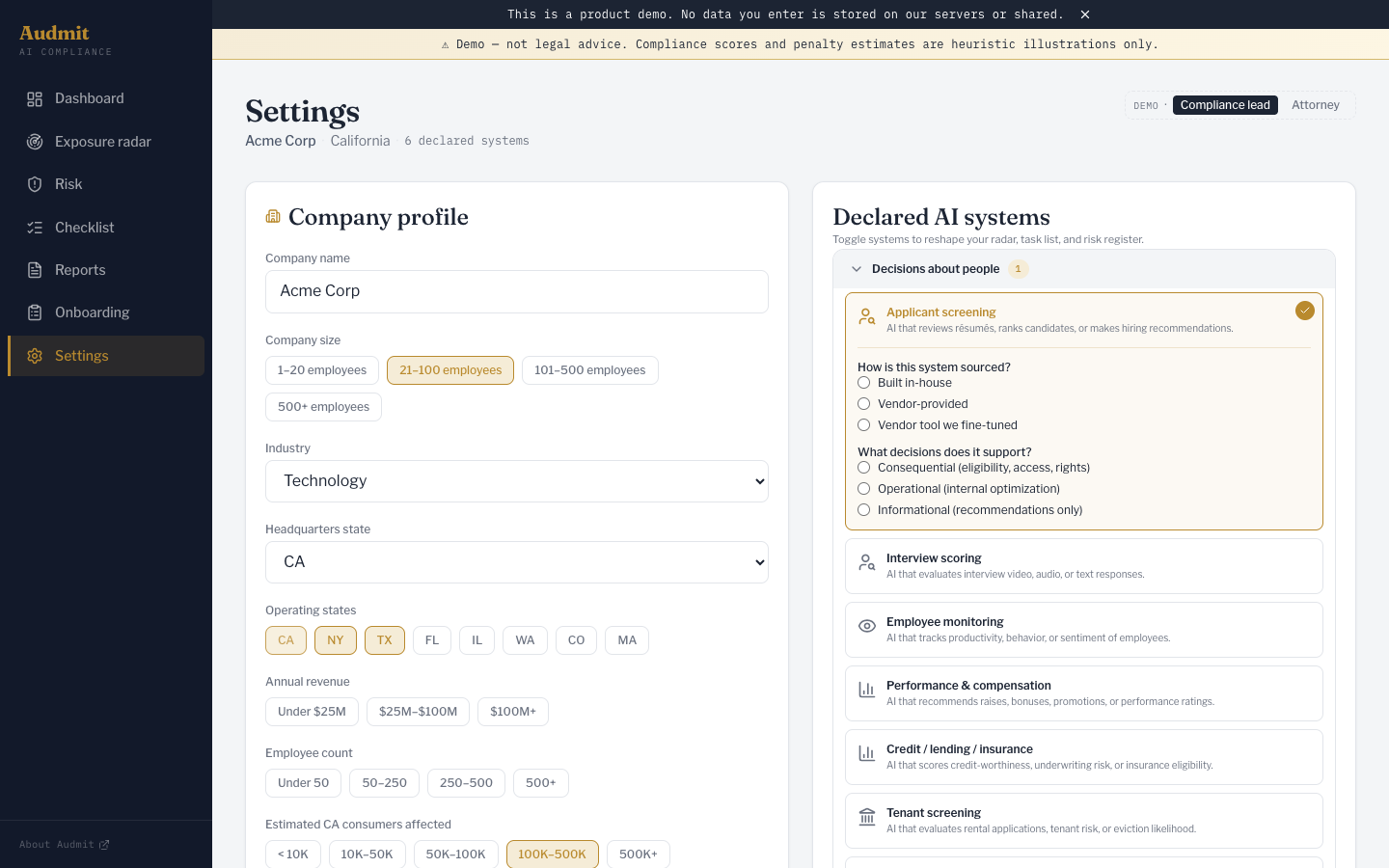
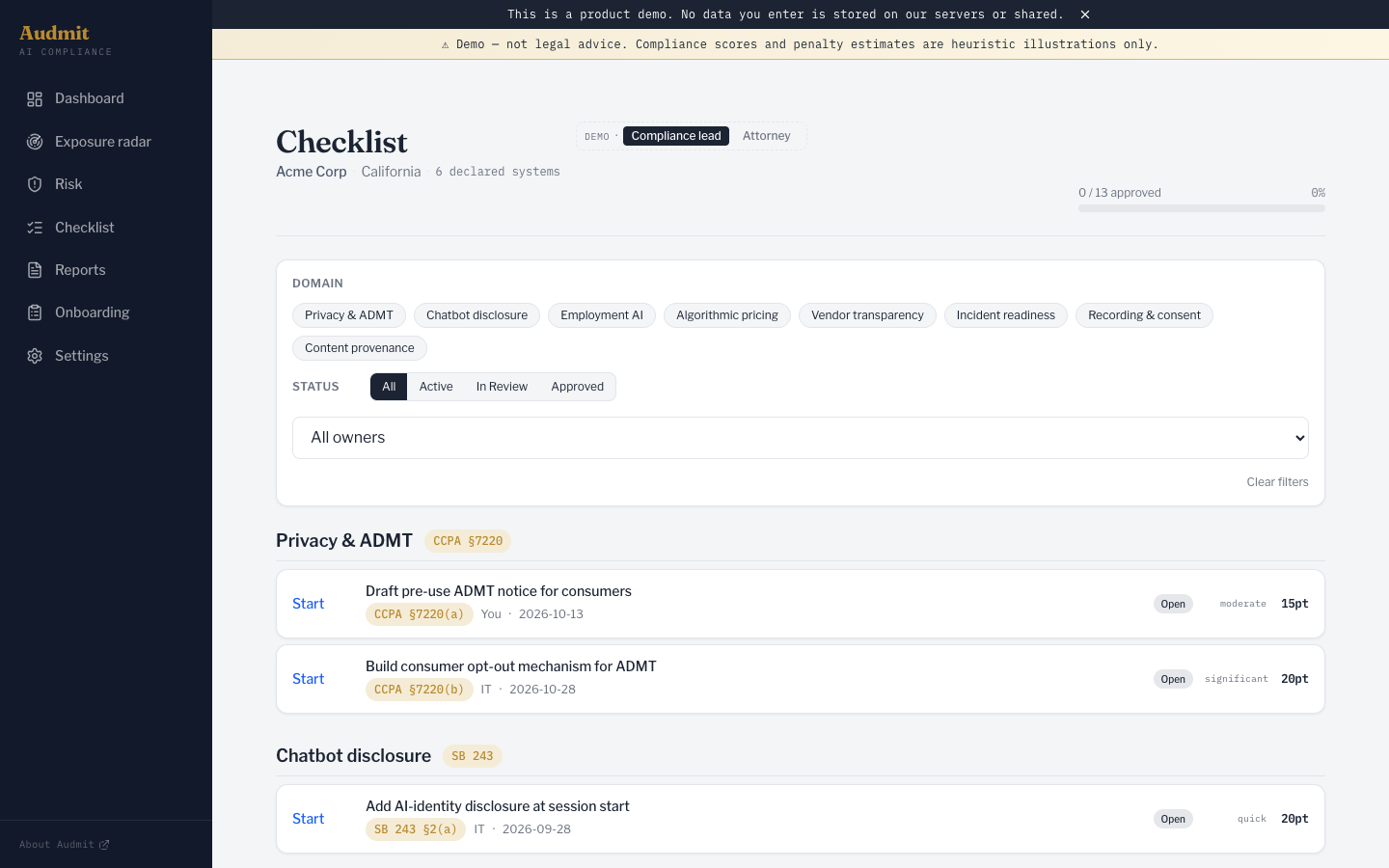
Screenshots from the Audmit compliance platform — the same system your team and your attorney of record use to track obligations.
Obligation checklist
Every obligation is broken into actionable items. Track progress system by system with clear ownership and deadlines.
Attorney review
Your named attorney of record reviews each obligation closure. Nothing ships without legal sign-off.
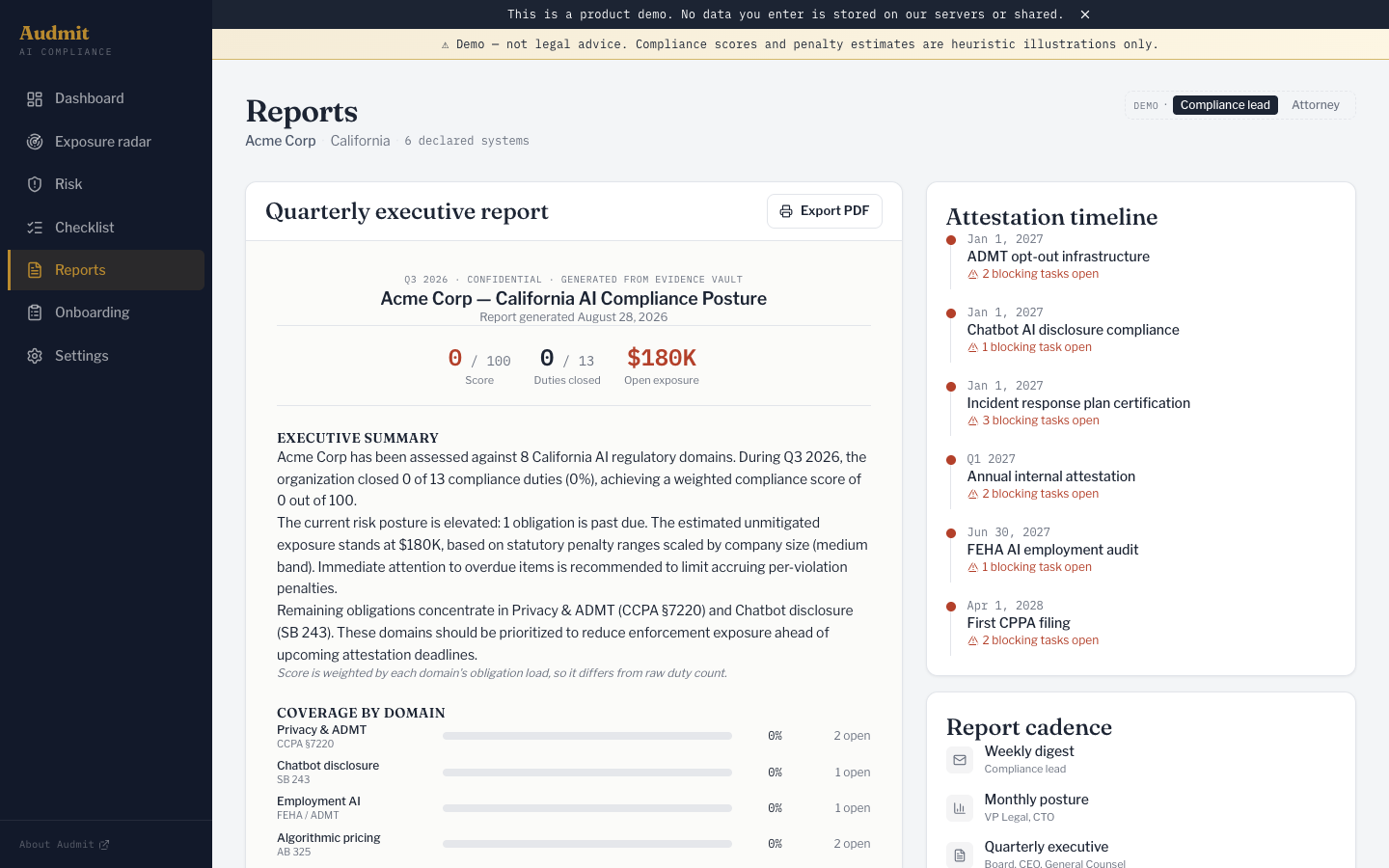
Quarterly report
Board-ready summaries show your compliance posture, what changed, and what's coming next.
Find out what applies — in ten minutes
Our free self-assessment maps your AI systems to California's obligation families. No account required.